Celebrating UAE Flag Day (November 3): Teaching Kids Arabic Through Colors, Symbols and Pride
What do the four colors of the UAE flag mean, and how can they teach your child Arabic? Flag Day is a beautiful chance to connect language with identity.
Every year on November 3, something special happens across the United Arab Emirates. Schools gather their students in the courtyard. Offices pause their meetings. Families stand on balconies and in front of their homes. And at the same moment, thousands of flags rise together into the sky, fluttering in red, green, white and black.
For children, Flag Day is exciting. There are flags to wave, songs to sing, crafts to make and a feeling of togetherness that is hard to describe. But for parents who want their children to learn Arabic, Flag Day is something more. It is a ready-made lesson in vocabulary, culture and belonging, wrapped in a celebration that children already love.
At KALIMA, we have taught Arabic to children for more than nine years, both in Dubai and to families around the world. We have seen how much easier it is for children to learn Arabic when the words are connected to something they care about. And few things spark a child’s pride like their flag.
In this guide, we will explore the story behind UAE Flag Day, the meaning of each color, the Arabic words your child can learn from the flag and a collection of fun activities that turn this national celebration into a joyful Arabic lesson. Whether you live in Abu Dhabi, Dubai, Sharjah or far away in London or Toronto with roots in the Emirates, this day belongs to your child too.
What Is UAE Flag Day?
UAE Flag Day, known in Arabic as يوم العلم (Yawm Al Alam), is celebrated every year on November 3. The day was introduced in 2013 to mark the anniversary of Sheikh Khalifa bin Zayed Al Nahyan taking office as President of the UAE in 2004.
Since then, Flag Day has become one of the most loved national occasions in the country. Traditionally, flags are raised together across the nation in the late morning, in schools, government buildings, companies and homes. People stand side by side, sing the national anthem and celebrate the unity of the seven emirates.
For children, it is often their first experience of feeling part of something much bigger than themselves. That feeling is a powerful foundation for learning the language of their country and their heritage.
A short history of the flag
The UAE flag was raised for the first time on December 2, 1971, the day the federation was established. It was designed by a young Emirati, Abdullah Mohammed Al Maainah, who was still a teenager when his design was chosen. Children love hearing this part of the story, because it shows them that young people can create something that lasts for generations.
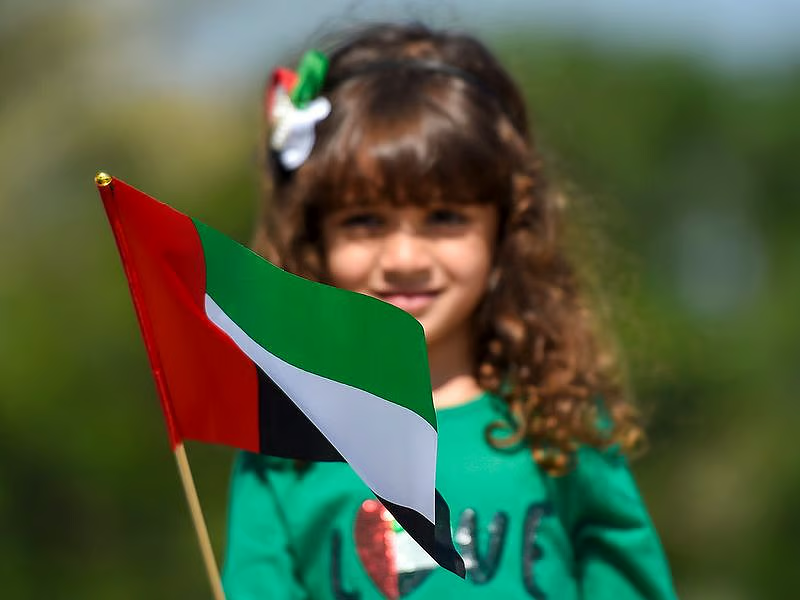
The flag has four colors arranged in a simple and striking design: a vertical red band on the side closest to the flagpole, and three horizontal stripes of green, white and black.
The Four Colors of the UAE Flag and What They Represent
One of the best ways to start teaching Arabic language through the flag is by learning the four colors. Each color is a word, and each word carries a meaning that children can understand and remember.
The meanings below are the ones most often shared in schools and celebrations. They are inspired by a famous line of classical Arabic poetry that speaks of white deeds, black battles, green lands and red swords. Families and teachers describe them in slightly different ways, but the spirit is the same.
Red: أحمر (ahmar)
Red is the vertical band beside the flagpole. It is often said to represent courage, strength and the sacrifices of those who came before. For children, you can describe red as the color of bravery, the color of a heart that is strong.
Arabic tip: ahmar is used with masculine words. For feminine words, it becomes hamraa’ (حمراء).
Green: أخضر (akhdar)
Green is the top horizontal stripe. It is commonly linked to hope, growth and the fertility of the land. In a country that has transformed parts of the desert into gardens, parks and farms, green is a symbol children can easily see around them.
Arabic tip: the feminine form is khadraa’ (خضراء).
White: أبيض (abyad)
White is the middle stripe. It represents peace, honesty and good deeds. You can explain to your child that white is the color of kindness and of a clean, good heart.
Arabic tip: the feminine form is baydaa’ (بيضاء).
Black: أسود (aswad)
Black is the bottom stripe. It is often described as a symbol of strength and the determination to overcome difficulties. Some families also connect it to the oil that changed the history of the country.
Arabic tip: the feminine form is sawdaa’ (سوداء).
Once your child knows these four words, they have learned some of the most useful color words in the Arabic language. And because they learned them through the flag, they will remember them with a feeling of pride.
Flag Day Arabic Vocabulary for Kids
Beyond the colors, Flag Day offers a whole collection of meaningful Arabic words. Here are some of our favorites to teach your child this November.
علم (alam): flag
The most important word of the day. Your child can say “hadha alam al imaraat” (هذا علم الإمارات), meaning “This is the flag of the Emirates.”
وطن (watan): homeland
Watan is a word full of emotion. It means homeland or nation, the place where your heart belongs. A beautiful phrase for children is “uhibbu watani” (أحب وطني), meaning “I love my homeland.”
الإمارات (al imaraat): the Emirates
The name of the country itself. The full name is الإمارات العربية المتحدة (al imaraat al arabiyya al muttahida), the United Arab Emirates. Older children enjoy the challenge of saying the full name.
اتحاد (ittihaad): union
Ittihaad means union or unity. It is at the heart of the UAE story, where seven emirates came together as one nation. You can explain it to children as “being stronger together.”
فخر (fakhr): pride
Fakhr means pride. A child might say “ana fakhoor bi baladi” (أنا فخور ببلدي) for a boy or “ana fakhoora bi baladi” (أنا فخورة ببلدي) for a girl, meaning “I am proud of my country.”
يرفع (yarfa’): to raise
On Flag Day, we raise the flag. You can teach your child “narfa’ al alam” (نرفع العلم), meaning “We raise the flag.”
سلام (salaam): peace
Connected to the white stripe, salaam is a word children already know from the greeting “as salaamu alaykum.” Flag Day is a lovely moment to explain that the same word appears in their daily greeting and in the meaning of their flag.
نشيد (nasheed): anthem or song
The national anthem of the UAE is called “Ishy Bilady” (عيشي بلادي), meaning “Long live my country.” Children often sing it at school, and learning the meaning of its opening words in Arabic helps them feel more connected when they sing.
Fun Flag Day Activities to Learn Arabic at Home
Celebrations are the perfect setting for learning, because children are already excited and engaged. Here are some activities from our KALIMA lessons that families can enjoy together.
Paint the flag and name the colors
Give your child paper, paints or colored paper and invite them to create their own UAE flag. As they paint each part, ask them to say the color in Arabic. “Ma hadha al lawn?” (What is this color?) “Ahmar!” When the flag is complete, help them write the word علم above it.
For older children, add a challenge: write the meaning of each color under its stripe in Arabic, using simple words like shajaa’a (courage), salaam (peace) and amal (hope).
Color treasure hunt
Hide red, green, white and black objects around the house. Call out a color in Arabic and let your child race to find something of that color. “Ibhath an shay’ akhdar!” (Look for something green!). This game builds listening skills and quick recall, and children never seem to get tired of it.
Make a flag fruit plate
Use fruit and food to recreate the flag on a plate: strawberries or watermelon for red, kiwi or grapes for green, banana or yogurt for white and blackberries or dates for black. Name each food in Arabic as you build the plate. Then enjoy the most delicious Arabic lesson of the year.
Flag-raising ceremony at home
Organize a small family ceremony on the morning of November 3. Let your child hold the flag, stand tall and raise it while everyone says “narfa’ al alam.” Play the national anthem and talk about what the flag means to your family. Even children living abroad can take part from their living room and feel connected to the celebrations back home.
Draw your dream for the UAE
Ask your child to draw a picture of what they love most about the UAE or their dream for its future. Then help them write one sentence in Arabic to describe the picture. It might be “uhibbu al bahr” (I love the sea) or “uhibbu madrasati” (I love my school). This simple activity mixes creativity, writing and emotional connection.
Puppet show: the story of the flag
At KALIMA, puppet shows are one of our favorite tools for teaching Arabic. At home, you can create simple puppets from socks or paper bags and act out the story of a young man who designed a flag that became a symbol for a whole nation. Encourage your child to give the puppets lines in Arabic, even simple ones like “uhibbu al alam” (I love the flag) or “hadha lawn ahmar.”
Sing and move
Music is one of the fastest ways to learn new words. Sing national songs together, or create your own simple song using the four colors. Something as simple as “ahmar, akhdar, abyad, aswad, hadha alami, hadha watani” sung to a familiar tune can become your child’s favorite Flag Day chant.
Why Connecting Arabic to National Identity Matters
Language and identity are deeply connected. When children learn Arabic through symbols they love, such as their flag, their homeland and their national celebrations, they are not just memorizing words. They are building a sense of who they are.
It builds emotional attachment to the language
Children who associate Arabic with pride, joy and belonging are far more motivated to keep learning. Flag Day creates exactly those positive emotions.
It makes learning meaningful
Abstract grammar rules rarely inspire children. A flag waving in the wind, a song sung with friends and a story about a teenager who designed a national symbol are far more memorable.
It strengthens family bonds
When parents and grandparents share their memories of national celebrations, children hear stories in Arabic that connect generations. These conversations are often more valuable than any worksheet.
It supports success at school
For children enrolled in schools in the UAE, Arabic is an important part of the curriculum. Arabic lessons for kids in UAE schools often include national identity themes, especially around November and December. Practicing vocabulary at home gives children a confidence boost in class.
Flag Day for Families Living Outside the UAE
Many families with Emirati roots or strong connections to the UAE live abroad, in the UK, the USA, Canada, Europe and beyond. For these children, Flag Day can be a meaningful way to stay connected to their heritage.
Here are a few ideas for celebrating from afar:
Hang a small UAE flag in your child’s bedroom or play area during November.
Join a video call with family members in the UAE during their flag-raising moment.
Watch videos of Flag Day celebrations together and describe what you see in Arabic.
Cook a traditional Emirati dish such as luqaimat or machboos and name the ingredients in Arabic.
Join online Arabic lessons that include cultural themes, so your child learns language and heritage together.
For families abroad, every celebration is an opportunity to remind children that Arabic is not a foreign language. It is their language.
Adapting Flag Day Learning to Your Child’s Age
Ages 3 to 5
Keep it colorful and physical. Focus on the four color words and the word alam. Use painting, stickers and movement games. Repetition and enthusiasm matter far more than accuracy.
Ages 6 to 8
Introduce short sentences like “hadha alam al imaraat” and “uhibbu watani.” Encourage your child to copy the Arabic words for each color under their drawing of the flag. Simple reading practice with labels works very well at this stage.
Ages 9 to 12
Older children can learn the full name of the country, the masculine and feminine forms of the colors and a few lines of the national anthem. Invite them to research the history of the flag and present it to the family in Arabic, even if it is just a few sentences.
A Five-Day Flag Week Plan for Busy Families
Flag Day falls on a Tuesday this year, so the days leading up to it are a perfect window for short, focused Arabic practice. Here is a simple plan that takes about ten minutes a day.
Day 1: Meet the flag
Show your child a picture of the UAE flag and introduce the word alam. Ask them to point to each stripe while you name the color in Arabic. End with the sentence “hadha alam al imaraat.” Keep it light and playful, and let your child hold a small flag while practicing.
Day 2: Colors everywhere
Spend the day spotting the four flag colors around you, at home, in the car or at the supermarket. Each time your child sees one, they shout the Arabic word. Younger children can collect objects in a basket, while older children can write a list of what they found in Arabic.
Day 3: The meaning behind the colors
Talk about what each color represents using simple Arabic words: shajaa’a (courage) for red, amal (hope) for green, salaam (peace) for white and quwwa (strength) for black. Ask your child which value they feel is most important and why. This short conversation turns vocabulary into reflection.
Day 4: Story time
Tell the story of the young designer who created the flag in 1971. Then ask your child to retell it using puppets or drawings. Encourage them to add Arabic words they have learned during the week. Do not worry about perfect grammar; the goal is confidence.
Day 5: Celebration rehearsal
Practice the phrases your child will use on Flag Day: “narfa’ al alam,” “uhibbu watani” and “ana fakhoor bi baladi.” Hold a small rehearsal at home with a flag, music and plenty of applause. By the time November 3 arrives, your child will feel ready to celebrate in Arabic.
This kind of short, repeated practice is exactly how children build lasting vocabulary. Five days of joyful exposure will do more than one long lesson ever could, and the pride your child feels on the day will make the words stick.
Frequently Asked Questions About UAE Flag Day for Kids
When is UAE Flag Day celebrated?
UAE Flag Day is celebrated every year on November 3. It marks the anniversary of Sheikh Khalifa bin Zayed Al Nahyan becoming President of the UAE in 2004.
What do the colors of the UAE flag mean?
The colors are commonly described this way: red for courage and sacrifice, green for hope and growth, white for peace and good deeds, and black for strength and determination. Interpretations vary slightly, but they all celebrate the values of the nation.
Who designed the UAE flag?
The UAE flag was designed by Abdullah Mohammed Al Maainah in 1971, when he was still a young man. It was raised for the first time on December 2, 1971.
How do you say flag in Arabic?
The Arabic word for flag is alam (علم). Flag Day is called Yawm Al Alam (يوم العلم).
How can I teach my child Arabic through national celebrations?
Use the celebration as a theme for vocabulary, songs, crafts and stories. Focus on words connected to the day, such as colors, flag, homeland and pride, and repeat them in fun activities throughout the week. If you want extra support, KALIMA offers one-on-one online Arabic lessons for kids that bring culture and language together.
Can children outside the UAE learn Arabic online?
Yes. KALIMA teaches children in the UAE and around the world through live, interactive online lessons. Children can learn Arabic online for kids from home, wherever they live, with teachers who make every class engaging and personal.
Let the Flag Inspire Your Child’s Arabic Journey
When the flag rises on November 3, your child will see red, green, white and black dancing in the wind. With a little help from you, they will also hear the Arabic words for those colors, understand the meaning behind them and feel proud to say them out loud.
That is what teaching Arabic language should feel like: not a chore, but a celebration. A flag is more than fabric, and a word is more than a sound. Both carry stories, values and identity. When you bring them together, your child gains something that lasts far beyond one day in November.
So this Flag Day, grab some paint, raise a flag, sing a song and let your child discover that Arabic is the language of their pride.
Learn Arabic with KALIMA
Learning Arabic can feel challenging for kids, but it does not have to feel hard. At KALIMA, we believe the best way to learn Arabic is to be attentive to the words and to have fun along the way. With more than 9 years of experience in teaching Arabic, our mission is to grow every child’s interest in, and love for, their mother language.
Our one on one online Arabic classes are tailored to each child’s needs, level and pace. We learn through games, puppet shows, drawing, dancing, singing and creating stories, so every lesson feels like play. Our three main courses cover the Arabic language itself, Arabic reading and Arabic writing, giving your child a complete and confident foundation.
Whether your family lives in Dubai, London, Toronto, New York, Paris or anywhere in between, your child can learn Arabic online with a KALIMA teacher who makes every word count.
Book your child’s first lesson today. Message us on WhatsApp and let’s start this Arabic adventure together.
KALIMA: Arabic lessons for kids, the happy and fun way.
Contact us on 📞 +961 81 701 455 📧 info@kalima-lessons.com
Recommended Read: 15 Autumn Arabic Words Every Child Should Learn This Season (With Fun Activities)